http://neo.jpl.nasa.gov/orbits/images/test9472.gif
http://antwrp.gsfc.nasa.gov/apod/image/1010/hartley2pacman_fernandez.jpg
via
http://antwrp.gsfc.nasa.gov/apod/astropix.html
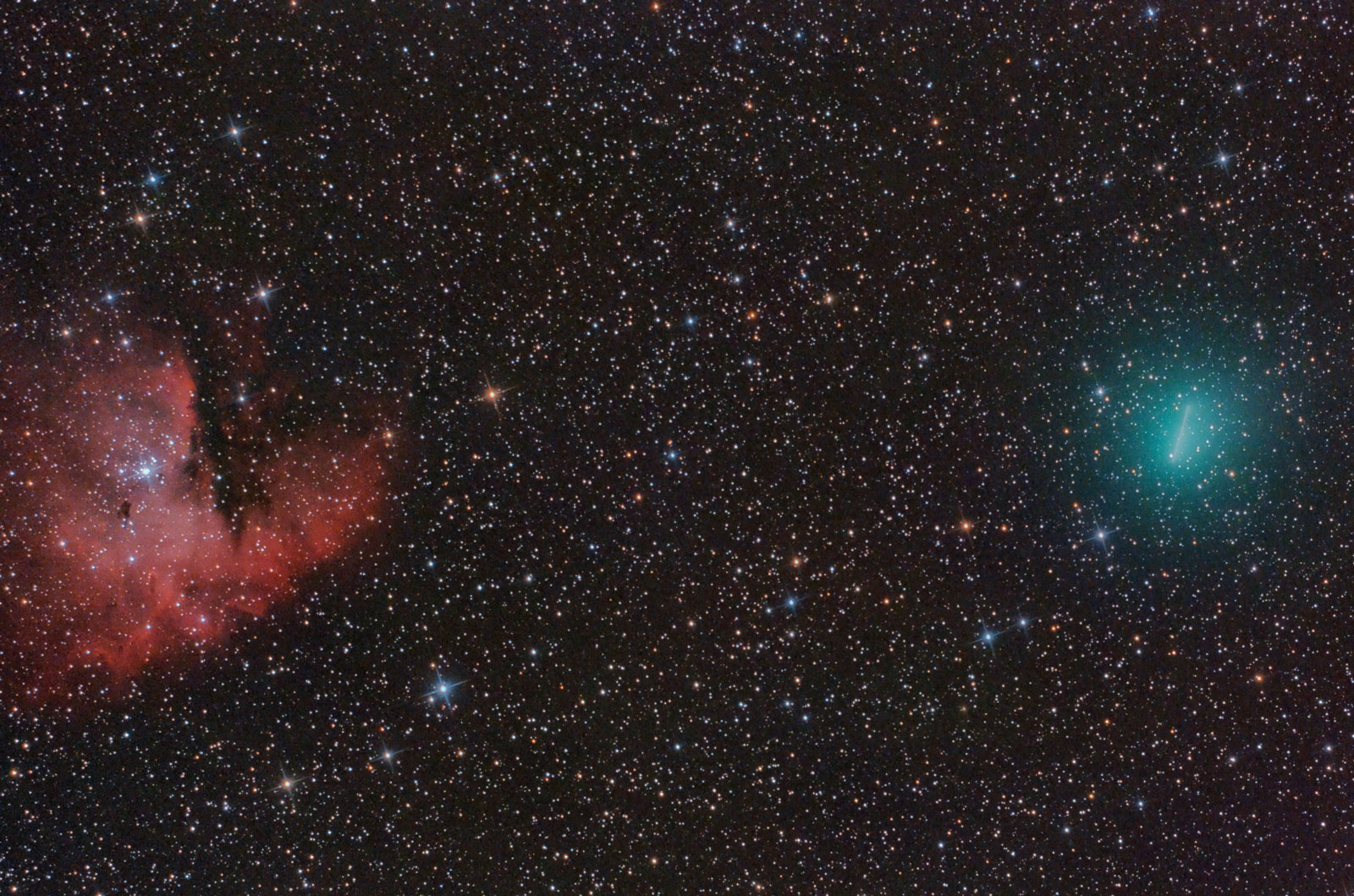
Explanation: Touring the solar system with a 6 year orbital period, small comet Hartley 2 (103/P Hartley) will make its closest approach to planet Earth on October 20 and its closest approach to the Sun on October 28. It may become a naked-eye comet, just visible in clear, dark skies. Meanwhile the comet has been a tempting telescopic target, seen here with an alluring green coma as it shares the frame with emission nebula NGC 281 and stars of the constellation Cassiopeia on October 2. The nebula's gaping profile defined by dust clouds against the red glow suggests its more playful moniker, the Pacman Nebula. An apparent short bright streak shows the comet's motion against the background stars during the hour of accumulated exposure time. Over the next few days Comet Hartley 2's motion will also carry it across a field of view featuring the famous double star cluster in Perseus. On November 4 a spacecraft from planet Earth will actually fly within about 700 kilometers of the comet's nucleus. Now dubbed EPOXI, that spacecraft was formerly known as Deep Impact.
quinta-feira, 7 de outubro de 2010


quarta-feira, 6 de outubro de 2010
actividade física
Artigos de referência com abordagem evolucionária à importância da actividade física, ou as razões científicas para você não passar muitas horas sentado nessa cadeira
Survival of Homo sapiens during evolution was dependent on the procurement of food, which in turn was dependent on physical activity. However, food supply was never consistent. Thus it is contended that the ancient hunter-gatherer had cycles of feast and famine, punctuated with obligate periods of physical activity and rest. Hence, gene selection in the Late-Paleolithic era was probably influenced by physical activity and rest. To ensure survival during periods of famine, certain genes evolved to regulate efficient intake and utilization of fuel stores. Such genes were termed "thrifty genes" in 1962. Furthermore, convincing evidence shows that this ancient genome has remained essentially unchanged over the past 10,000 years and certainly not changed in the past 40-100 years. Although the absolute caloric intake of modern-day humans is likely lower compared with our hunter-gatherer ancestors, it is nevertheless in positive caloric balance in the majority of the US adult population mainly due to the increased sedentary lifestyle in present society. We contend that the combination of continuous food abundance and physical inactivity eliminates the evolutionarily programmed biochemical cycles emanating from feast-famine and physical activity-rest cycles, which in turn abrogates the cycling of certain metabolic processes, ultimately resulting in metabolic derangements such as obesity and Type 2 diabetes. In this context, we postulate that perhaps a crucial mechanism to break the stall of the metabolic processes would be via exercise through the regulation of "physical activity genes," some of which may also be potential candidates for the "thrifty genes" of our hunter-gatherer ancestors. Therefore, the identification of such "thrifty gene" candidates would help provide insight into the pathogenetic processes of the numerous physical inactivity-mediated disorders.
A sobrevivência do Homo sapiens durante a evolução foi dependente da aquisição de alimentos, que por sua vez era dependente de atividade física. Contudo, a oferta de alimentos nunca foi consistente. Assim, é defendido que os antigos caçadores-coletores tinham ciclos da festa e da fome, pontuada com períodos obrigatórios de atividade física e descanso. Assim, a seleção genética na era tardia Paleolítico foi provavelmente influenciado pela atividade física e descanso. Para garantir a sobrevivência durante os períodos de fome, alguns genes evoluíram para regular a ingestão e eficiência da utilização das reservas de combustível. Tais genes eram chamados de "genes econômicos", em 1962. Além disso, mostra uma evidência convincente de que este genoma antiga permaneceu praticamente inalterada nos últimos 10 mil anos e certamente não mudou nos últimos 4-10 anos. Embora a ingestão calórica absoluta dos seres humanos modernos é provável menor em comparação com os nossos antepassados caçadores-coletores, é, no entanto, no balanço calórico positivo na maioria da população adulta dos EUA, principalmente devido ao estilo de vida sedentário aumentou na sociedade atual. Defendemos que a combinação de abundância alimentar contínua e inatividade física elimina os ciclos bioquímicos evolutivamente programados provenientes de fome de festa e ciclos de actividade física resto, o que anula a ciclagem de certos processos metabólicos, resultando em distúrbios metabólicos como obesidade e A diabetes tipo 2. Neste contexto, postulamos que, talvez, um mecanismo crucial para quebrar a banca dos processos metabólicos seria através de exercícios através da regulação dos genes "atividade física", alguns dos quais também podem ser potenciais candidatos para o "genes econômicos" do nosso caçador -coletores ancestrais. Portanto, a identificação de tal "gene econômico" candidatos ajudaria a prover insights sobre os processos patogenéticos das inúmeras desordens físicas inatividade mediada.
Ouvir
Ler foneticamente
Dicionário - Ver dicionário detalhado
http://www.canibaisereis.com/2010/04/27/actividade-fisica-evolucionaria/
Survival of Homo sapiens during evolution was dependent on the procurement of food, which in turn was dependent on physical activity. However, food supply was never consistent. Thus it is contended that the ancient hunter-gatherer had cycles of feast and famine, punctuated with obligate periods of physical activity and rest. Hence, gene selection in the Late-Paleolithic era was probably influenced by physical activity and rest. To ensure survival during periods of famine, certain genes evolved to regulate efficient intake and utilization of fuel stores. Such genes were termed "thrifty genes" in 1962. Furthermore, convincing evidence shows that this ancient genome has remained essentially unchanged over the past 10,000 years and certainly not changed in the past 40-100 years. Although the absolute caloric intake of modern-day humans is likely lower compared with our hunter-gatherer ancestors, it is nevertheless in positive caloric balance in the majority of the US adult population mainly due to the increased sedentary lifestyle in present society. We contend that the combination of continuous food abundance and physical inactivity eliminates the evolutionarily programmed biochemical cycles emanating from feast-famine and physical activity-rest cycles, which in turn abrogates the cycling of certain metabolic processes, ultimately resulting in metabolic derangements such as obesity and Type 2 diabetes. In this context, we postulate that perhaps a crucial mechanism to break the stall of the metabolic processes would be via exercise through the regulation of "physical activity genes," some of which may also be potential candidates for the "thrifty genes" of our hunter-gatherer ancestors. Therefore, the identification of such "thrifty gene" candidates would help provide insight into the pathogenetic processes of the numerous physical inactivity-mediated disorders.
A sobrevivência do Homo sapiens durante a evolução foi dependente da aquisição de alimentos, que por sua vez era dependente de atividade física. Contudo, a oferta de alimentos nunca foi consistente. Assim, é defendido que os antigos caçadores-coletores tinham ciclos da festa e da fome, pontuada com períodos obrigatórios de atividade física e descanso. Assim, a seleção genética na era tardia Paleolítico foi provavelmente influenciado pela atividade física e descanso. Para garantir a sobrevivência durante os períodos de fome, alguns genes evoluíram para regular a ingestão e eficiência da utilização das reservas de combustível. Tais genes eram chamados de "genes econômicos", em 1962. Além disso, mostra uma evidência convincente de que este genoma antiga permaneceu praticamente inalterada nos últimos 10 mil anos e certamente não mudou nos últimos 4-10 anos. Embora a ingestão calórica absoluta dos seres humanos modernos é provável menor em comparação com os nossos antepassados caçadores-coletores, é, no entanto, no balanço calórico positivo na maioria da população adulta dos EUA, principalmente devido ao estilo de vida sedentário aumentou na sociedade atual. Defendemos que a combinação de abundância alimentar contínua e inatividade física elimina os ciclos bioquímicos evolutivamente programados provenientes de fome de festa e ciclos de actividade física resto, o que anula a ciclagem de certos processos metabólicos, resultando em distúrbios metabólicos como obesidade e A diabetes tipo 2. Neste contexto, postulamos que, talvez, um mecanismo crucial para quebrar a banca dos processos metabólicos seria através de exercícios através da regulação dos genes "atividade física", alguns dos quais também podem ser potenciais candidatos para o "genes econômicos" do nosso caçador -coletores ancestrais. Portanto, a identificação de tal "gene econômico" candidatos ajudaria a prover insights sobre os processos patogenéticos das inúmeras desordens físicas inatividade mediada.
Ouvir
Ler foneticamente
Dicionário - Ver dicionário detalhado
http://www.canibaisereis.com/2010/04/27/actividade-fisica-evolucionaria/
segunda-feira, 4 de outubro de 2010
Antigos Arquivos
Ancient X Files from Alex Harrison on Vimeo.
Título sequência de uma nova série para a National Geographic, juntamente com uma pequena edição de algumas das animações criadas para a mostra.
sábado, 2 de outubro de 2010
ALI_SE: Hibernar e a depressão
ALI_SE: Hibernar e a depressão: "Basta procurar ou pesquisar sobre as palavras depressão e afins termos, que é de bradar aos céus o que se escreve sobre estas matérias. A cu..."
Subscrever:
Mensagens (Atom)